OEM / ODM
Custom Pet Product Quotation Checklist: What to Prepare Before You Contact a Manufacturer
A useful custom pet product inquiry starts with 3D drawings or a physical sample. This checklist helps buyers organize the product reference, colors, labels, cartons and assembly requirements before contacting KANAPET, and understand which details still need review before production.
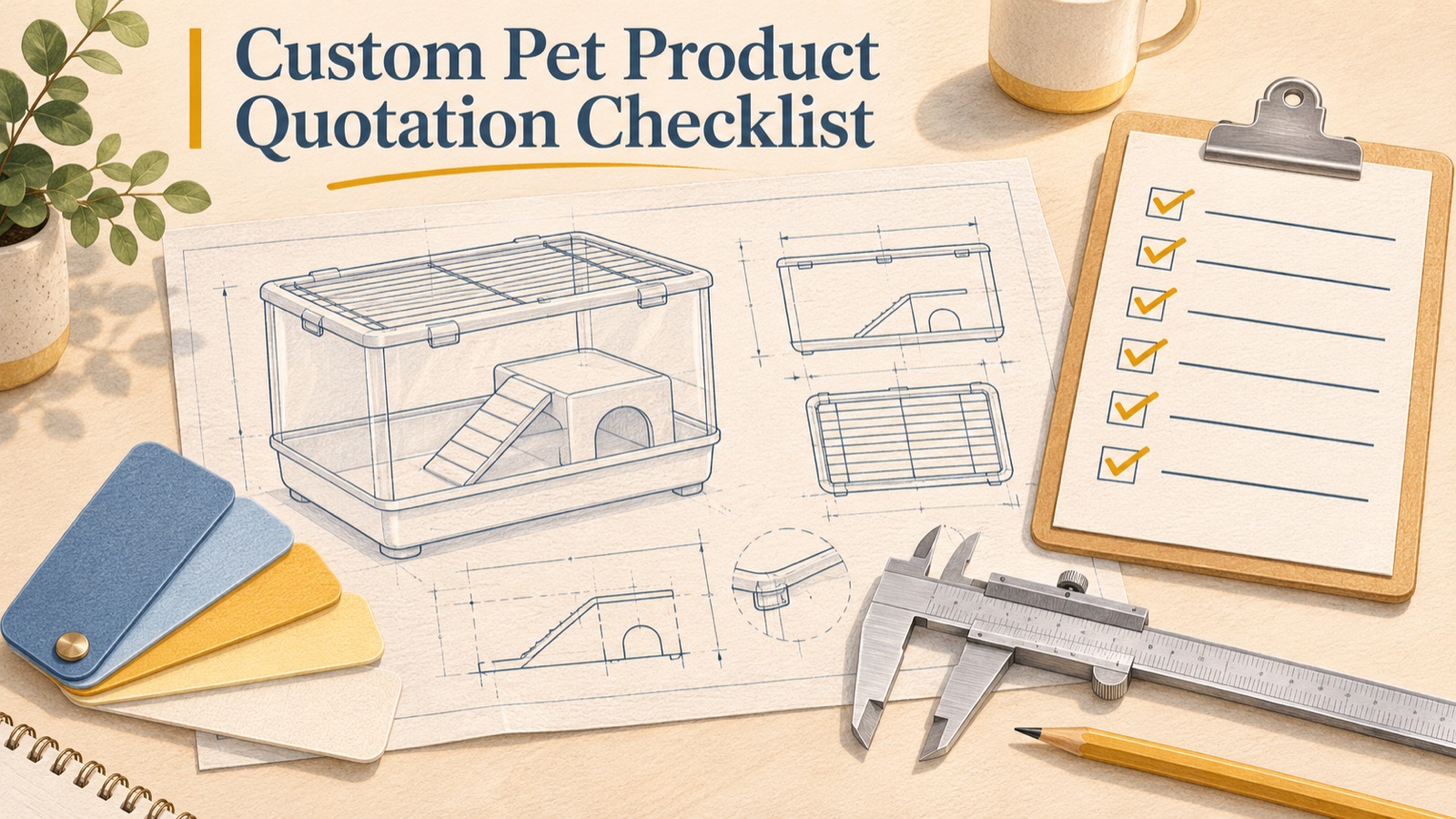
Table of Contents
Cover illustration: AI-generated editorial concept, not a KANAPET product drawing or production sample.
Start with a product that can be assessed
Before requesting a custom pet product quotation, prepare 3D drawings or a physical sample. KANAPET uses these materials to assess the product structure and manufacturing feasibility. An idea, a short description or a mood board alone does not provide enough information for an evaluation or quotation.
Drawings together with a physical sample are the preferred starting point. Drawings alone are acceptable. A physical sample alone can also be assessed, but the initial estimate is less precise without drawings. If your project is still an idea, first work with a product designer or design team to prepare the drawings.
This checklist focuses on the information to organize before your inquiry. For the complete sequence after that, read how KANAPET develops a custom pet product.
Identify the exact version you want quoted
Give the project a clear name and identify the drawing or sample version you want reviewed. When you send several files, explain which one represents the current requirement and which ones are references. A photograph can help explain a detail, but it does not replace the drawings or physical sample required for assessment.
Separate decisions already made from alternatives you want to discuss. For example, if two colors are still being considered, list them as options instead of describing both as approved production requirements.
| Information to organize | What to include |
|---|---|
| Product reference | The 3D drawings or physical sample to be assessed |
| Version | A clear file revision or sample identifier |
| Requested changes | The parts or details you want changed from that reference |
| Open decisions | Options that still need discussion or confirmation |
If you are sourcing an existing item rather than developing a new one, start from the product catalog and identify the relevant product. Explain the customization you want assessed so the discussion begins with a specific reference.
Describe colors, labels and cartons separately
KANAPET offers custom colors, labels and cartons. Organize these requirements separately so that a product color change is not confused with a packaging or artwork change.
- Product colors: identify the parts and colors you want reviewed.
- Labels: provide the intended content, artwork and placement requirements.
- Cartons: describe the carton design and packing requirements.
- Pending artwork: label unfinished files as drafts and identify what still needs approval.
Explain how the finished product should be assembled and packed
KANAPET assembles and packs products according to customer requirements. Include your intended arrangement in the inquiry rather than leaving it to be inferred from a product photograph.
Describe which components should be assembled, which should be packed separately, and what labels or other items you want included. If you have a packing reference, identify whether it is a requirement or simply an example for discussion.
These notes define what you want reviewed. They do not establish that every requested arrangement is feasible or included in an initial quotation; confirm the scope during the project discussion.
Understand what the initial quotation covers in the process
KANAPET first evaluates the available drawings and samples and provides an initial quotation. Detailed structural analysis and optimization follow acceptance of that quotation. The project then proceeds to 3D sampling, with sample confirmation before mold making.
Mold trials produce another set of samples for confirmation before mass production. Keep these stages distinct when planning your project: accepting an initial quotation does not mean that the structure, sample or production tooling has already been approved.
- Supply the drawings or physical sample for assessment.
- Review the initial quotation.
- After acceptance, proceed with detailed structural analysis and necessary optimization.
- Review and confirm the 3D sample before mold making.
- Confirm mold trial samples before mass production.
For the manufacturing services described on this website, see OEM / ODM cooperation.
Use this inquiry checklist
Before you contact us, check that your inquiry identifies the following:
- The product name and the current 3D drawing or physical sample reference.
- The changes you want assessed and any decisions still open.
- The colors, labels and carton requirements.
- The intended assembly and packing arrangement.
- Any supporting artwork, with its draft or confirmed status clearly marked.
Send the drawings through the agreed communication channel or contact KANAPET to arrange delivery of a physical sample. Starting with a clear product reference and an organized requirement list gives both sides a concrete basis for the assessment.
Key Takeaways
- Provide 3D drawings or a physical sample; an idea alone is insufficient for a KANAPET assessment or quotation.
- Identify the exact product version and separate confirmed requirements from options still under discussion.
- Include colors, label artwork, carton requirements and the intended assembly and packing arrangement.
- Initial quotation acceptance, 3D sample approval and mold trial sample approval are separate project stages.
Frequently Asked Questions
Can I request a quotation with only a product idea?
KANAPET needs 3D drawings or a physical sample for an assessment. If you only have an idea, work with a product designer or design team to prepare the drawings first.
Can KANAPET assess a physical sample without drawings?
Yes. A physical sample can be assessed, although the initial estimate is less precise without drawings. Drawings with a sample are preferable; drawings alone are also acceptable.
Should packaging requirements be included in the inquiry?
Yes. Share the colors, labels, cartons, assembly and packing requirements you want reviewed. Clearly mark artwork or packing decisions that are still provisional.